






Email:
Phone:
Fax:


The Azores are one of the nine outermost regions (ORs) of the European Union (EU).
The Conference of Presidents of the ORs is the main structure for political and technical cooperation between the presidents of the executive bodies of the Azores, the Canary Islands, Guadeloupe, Guyana, Madeira, Martinique, Mayotte, Réunion and Saint-Martin.
The Presidency of the Conference shall be rotating and shall be held for terms of at least one year and shall meet annually in ordinary session in the region holding the Presidency. Its conclusions take the form of a Final Declaration reflecting the common political positions of the ORs.
In 2021, the Presidency of the Conference of Presidents of the ORs (CPRUP) was held by the Azores, coinciding with the Portuguese Presidency of the Council of the EU that took place in the 1st half of 2021.
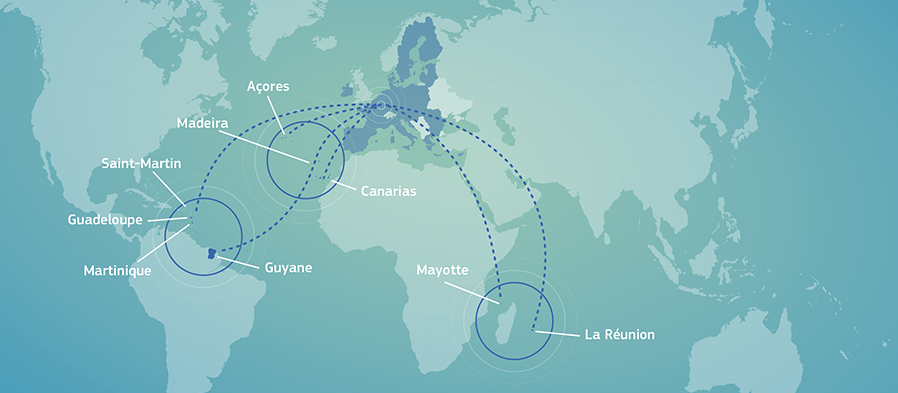
The ORs represent a group of eight islands and archipelagos distributed by the Caribbean Sea, Indian Ocean and Macaronesia, and a continental enclave in the Amazon rainforest, composed of six overseas French collectivities (Guyana, Guadeloupe, Martinique, Mayotte, Réunion and Saint-Martin), two Portuguese autonomous regions (Azores and Madeira) and one Spanish autonomous community (the Canary Islands).
These regions share specific constraints, the permanence and combination of which severely hamper their economic and social development:
- A great distance from the European continent, reinforced by insularity or even double insularity (in the case of archipelagos) or territorial encroachment (in the case of Guyana), makes it extremely difficult for these regions to benefit from the advantages of the EU internal market;
- integration within a dual space consisting, on the one hand, of a political and economic area of which it is a member and, on the other hand, of a geographical area close to third countries of the EU or a totally isolated space;
- the small size of the local market and economic dependence on a small number of products;
- Particular geographical and climatic conditions hindering the endogenous development of the primary and secondary sectors.
The concept of ultraperiphery in no way resembles that of regions of the European Union with particular geographical characteristics, such as islands, mountain areas or sparsely populated regions, for which there is a difference in nature and law. Thus, EU primary Community law recognises, in Article 349 of the Treaty on the Functioning of the European Union (TFEU), the specific nature of the outermost regions, expressly allowing the Council to adopt specific provisions to adapt the application of EU law to these regions.
In this regard, the Court of Justice of the European Union (CJEU), in its judgment of 15 December 2015, recognises that Article 349 TFEU constitutes an autonomous and sufficient legal basis for adopting specific measures aimed, in particular, at adapting European law to the reality of the outermost regions.
Find out more about the Outermost Regions: https://cp-rup.com/